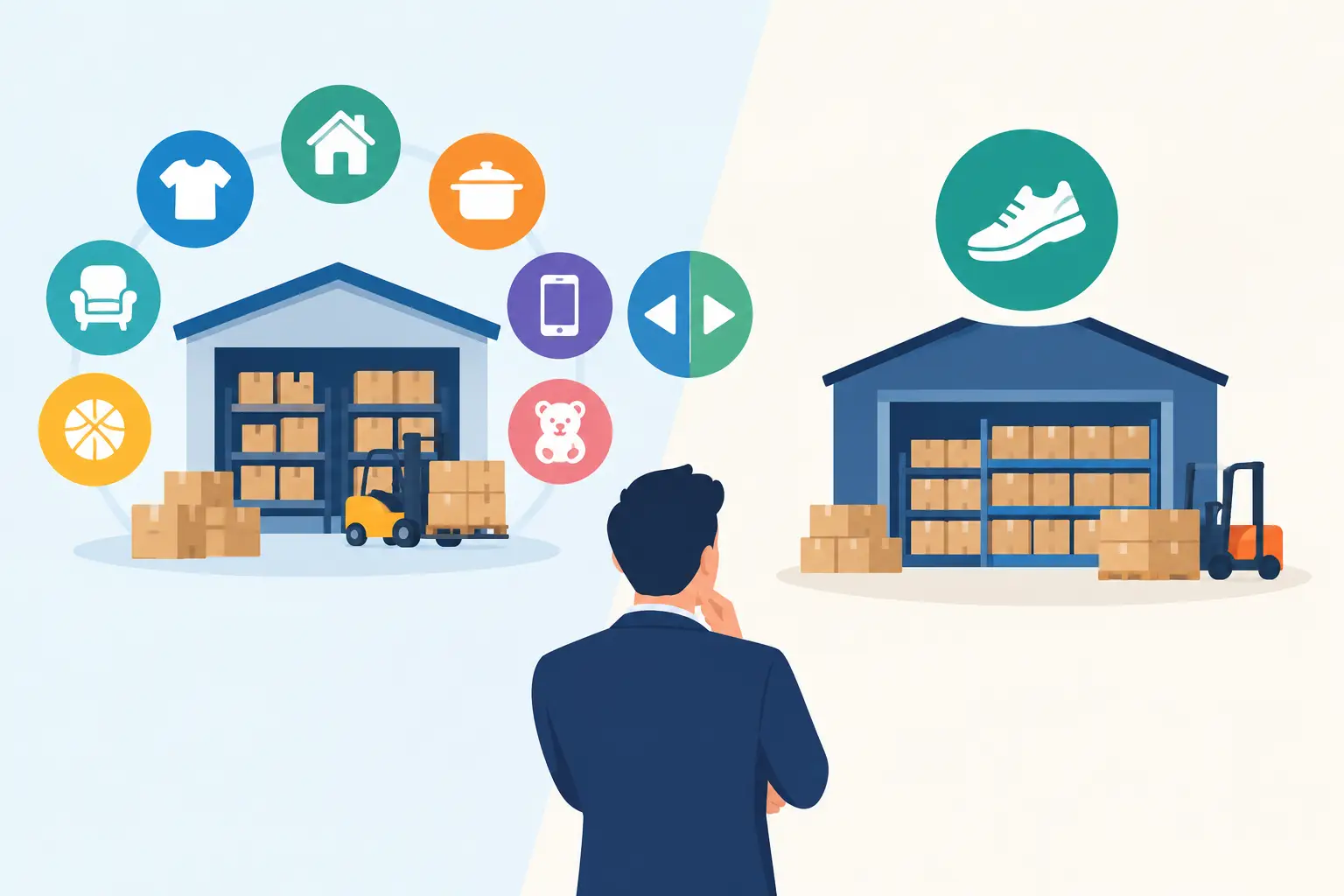

A missed shipment of everyday essentials can cost a retailer more than a delayed delivery of a niche item. That practical reality sits at the center of the multi category vs specialist suppliers decision. For wholesalers, distributors, importers, and retailers, the right sourcing model affects not only product selection, but also working capital, delivery coordination, margins, and the ability to serve customers consistently.
There is no single supplier model that fits every business. Specialist suppliers can offer deep product expertise and highly focused ranges. Multi-category suppliers can simplify procurement by making a broad mix of fast-moving goods available through one established trade partner. The most suitable choice depends on what you sell, how often you replenish, where you distribute, and how much administrative complexity your business can carry.
What Multi-Category Suppliers Bring to Wholesale Buyers
A multi-category supplier offers products across several unrelated or adjacent product lines. For a wholesale buyer, that can mean sourcing household goods, cleaning products, kitchenware, stationery, beauty items, baby products, tools, party supplies, and other consumer merchandise through fewer purchase orders and fewer supplier relationships.
The strongest advantage is commercial efficiency. Instead of managing separate quotations, payment terms, shipment schedules, and claims processes for every category, buyers can consolidate a substantial share of their purchasing. This reduces the time procurement teams spend on routine administration and gives owners a clearer view of inventory commitments.
Consolidation can also improve shipment economics. A buyer importing a container or arranging regional distribution may be able to combine complementary categories into one order. A mixed assortment can help fill an order to a practical volume while reducing the need to hold excess stock in a single category simply to meet a supplier’s minimum order requirement.
For retailers and resellers, product breadth supports more complete customer offerings. A neighborhood store, general merchandise outlet, online seller, or regional distributor often needs a balanced range of everyday products rather than a narrow selection. Buying from a broad-line trading partner makes it easier to respond to seasonal demand, test new categories, and replenish core items without rebuilding the supply chain each time.
Reliability matters as much as range. An experienced multi-category supplier with established import channels, warehousing capability, and export knowledge can provide continuity across recurring orders. That is particularly valuable for businesses serving several markets, where coordinating documentation, packing standards, and delivery schedules can become difficult when products come from many separate sources.
Where Specialist Suppliers Have an Advantage
Specialist suppliers focus their resources on one category or a closely related family of products. A supplier dedicated to professional beauty products, industrial tools, luggage, or a particular foodservice line may understand product specifications, technical requirements, category trends, and brand positioning in greater detail than a general trading source.
That expertise can be valuable when the product itself is central to your business identity. A retailer building a premium skincare assortment may need advanced product training, tightly controlled brand access, detailed ingredient information, or consultation on merchandising. A contractor supply business may require exact tool specifications, certifications, replacement parts, and technical after-sales support. In these cases, the depth of a specialist supplier can justify the added complexity of maintaining another vendor relationship.
Specialists may also provide a wider selection within their category. If a buyer needs dozens of variations of one item, including premium, professional, or niche options, a focused supplier may have a more complete assortment. This can help businesses differentiate their offer rather than compete only on price.
However, specialization does not automatically mean better value. A narrow supplier relationship can create dependency, particularly when minimum order quantities are high or stock availability changes. Buyers should compare the full cost of sourcing, including freight, lead time, payment conditions, inventory risk, and the internal work required to manage separate suppliers.
Multi Category vs Specialist Suppliers: The Real Trade-Off
The practical choice is usually not breadth versus quality. A well-managed multi-category supplier can deliver dependable quality merchandise across many lines, while a specialist can offer exceptional knowledge in a limited area. The real trade-off is between supply chain simplicity and category depth.
Choose a multi-category supplier when your business needs broad, repeatable stock across several consumer goods categories. This model is particularly suitable for general wholesalers, variety retailers, supermarkets, discount stores, export traders, and distributors building mixed loads for different customer segments. It works best when consistent availability, competitive pricing, and order consolidation are major priorities.
Choose a specialist supplier when one category drives a large share of revenue or requires technical credibility. This approach is suitable when customers expect expert guidance, when product compliance is complex, or when you need exclusive and highly differentiated merchandise. It can also be appropriate for a buyer that already has a mature procurement operation capable of managing many supplier relationships efficiently.
Many successful businesses use a combined model. They rely on a multi-category supplier for high-volume, everyday merchandise, then maintain selected specialist partnerships for strategic categories. This protects purchasing efficiency without sacrificing depth where it creates a clear commercial advantage.
Questions to Ask Before Selecting a Supplier
Before deciding, review the commercial role each category plays in your business. Start with demand: which items generate frequent orders, attract repeat customers, or help increase basket value? Core fast-moving lines are often strong candidates for consolidated sourcing because stock interruptions can quickly affect sales.
Then assess your order pattern. If you place smaller orders across many categories, a broad supplier may reduce minimum-order pressure and simplify replenishment. If you buy large quantities within one specialized category, a focused supplier may offer stronger scale benefits or a broader product choice.
Consider the operational requirements behind each order. Ask whether the supplier can provide dependable inventory visibility, consistent packaging, export-ready documentation, practical payment terms, and delivery support for your market. Competitive unit pricing is valuable, but it should not be evaluated in isolation. A lower-priced product can become costly if it arrives late, requires repeated follow-up, or leaves gaps in your shelf availability.
It is also wise to examine supplier stability. Long-term trade experience, established distribution relationships, and a clear track record of serving volume buyers are meaningful indicators. Procurement is not only a transaction. It is a recurring business relationship that must perform through demand spikes, seasonal changes, and changing market conditions.
Building a More Efficient Sourcing Strategy
The strongest sourcing strategy begins with a category-by-category view of your business, not a preference for one supplier type. Divide your assortment into core replenishment items, growth categories, seasonal opportunities, and specialist lines. Then match each group to the supplier model that supports its commercial purpose.
Core household and consumer goods often benefit from a broad supplier relationship because buyers need assortment, price consistency, and dependable replenishment. Growth categories may also benefit from a multi-category partner when the goal is to test demand without committing to large, narrow inventories. Specialist lines deserve separate attention when their margin, technical requirements, or brand value warrants it.
For businesses trading across borders, the supplier’s location and export capability should also influence the decision. Dubai remains a practical trading hub for buyers serving the Middle East, Africa, Asia, and international markets because it supports consolidation, re-export activity, and access to diverse merchandise. A company such as Fakhruddin General Trading can support buyers seeking a wide wholesale assortment through an established regional trading infrastructure, while allowing them to retain specialist partners where those add value.
The better question is not whether one model is universally superior. It is whether each supplier relationship makes your purchasing operation more dependable, more profitable, and easier to scale. Choose partners that help you keep essential products moving, manage inventory with confidence, and create room to pursue the categories that will grow your business next.