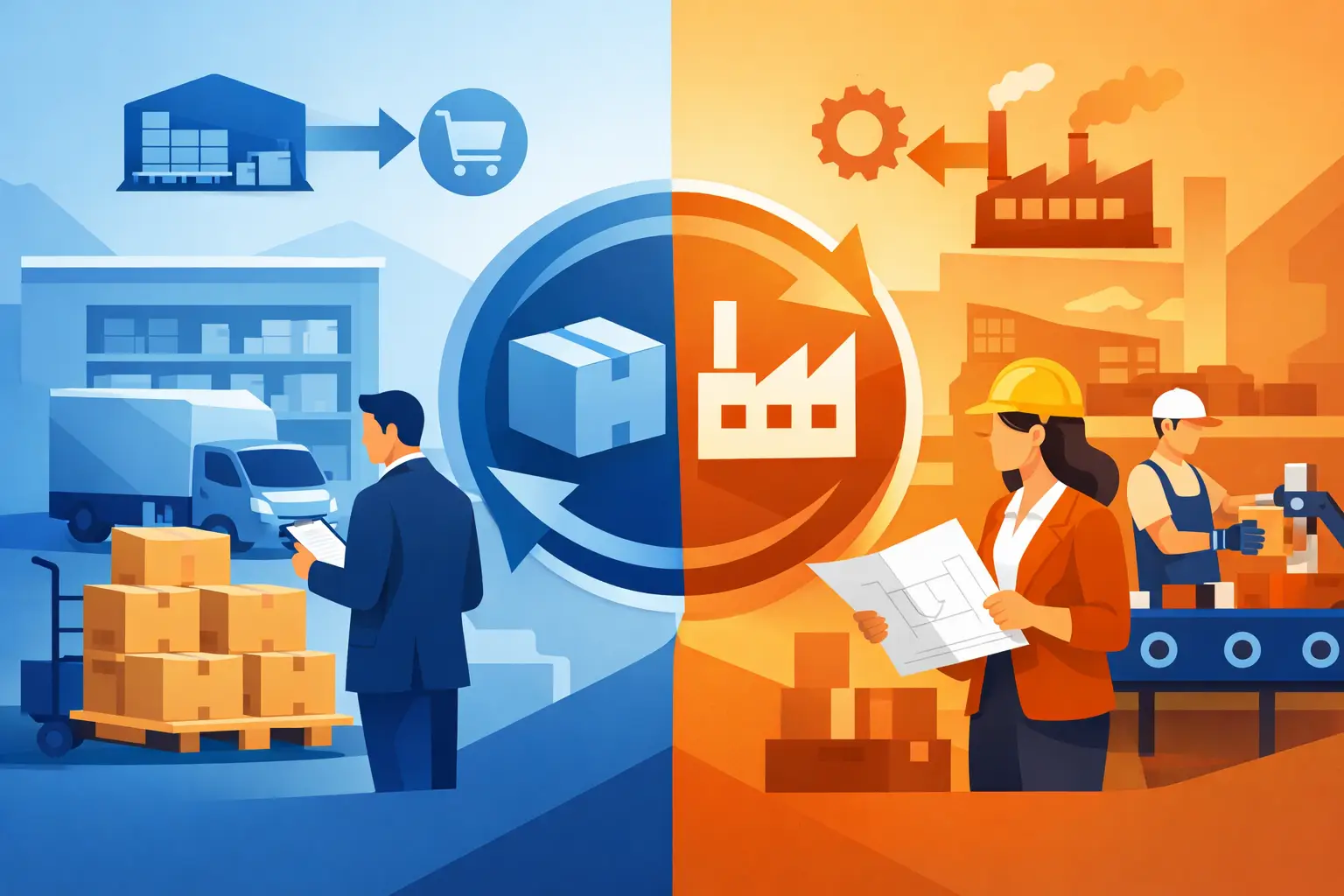

A wholesale supplier vs manufacturer decision affects far more than the unit price on an invoice. It shapes how quickly you can replenish stock, how many categories you can carry, how much capital you commit, and how reliably you can serve your own customers. For retailers, distributors, importers, and regional traders, the right route depends on the business model behind the order.
A manufacturer may be the strongest choice when product control and large-volume buying are central to the plan. A wholesale supplier is often the better commercial partner when speed, assortment, manageable order quantities, and dependable availability matter more. Understanding the distinction helps buyers source with greater confidence and avoid building unnecessary risk into their supply chain.
Wholesale Supplier vs Manufacturer: The Core Difference
A manufacturer makes products. It operates or manages the production process, purchases raw materials, sets production schedules, and produces goods under its own brand, a customer’s private label, or both. Manufacturers may sell directly to large buyers, but many focus on production rather than handling smaller, mixed, or frequent orders.
A wholesale supplier buys products in volume and resells them to businesses. The supplier may represent established brands, carry private-label goods, import merchandise, hold local inventory, and manage distribution across several markets. In some cases, a trading company also has manufacturing capabilities, creating a broader sourcing model for customers.
The difference is practical. A manufacturer gives a buyer more direct involvement in what is made. A wholesale supplier gives a buyer access to what is ready to sell. Neither is automatically better. The suitable choice depends on product needs, order scale, timing, and the level of complexity your business can manage.
What You Gain by Buying Direct From a Manufacturer
Buying directly from a manufacturer can create a clear cost advantage at high volume. Removing an intermediary may reduce the unit cost, particularly when the buyer is able to commit to full production runs and negotiate long-term purchasing terms. This model can be attractive for major distributors, national retail groups, and companies building a proprietary product line.
Manufacturers also offer the greatest potential for customization. A buyer may be able to specify materials, colors, dimensions, packaging, labeling, compliance requirements, and branding. That level of control is valuable when a business needs a differentiated product rather than an item widely available in the market.
However, direct manufacturing requires planning and purchasing discipline. Minimum order quantities are usually higher because production must be commercially viable. Lead times may include product development, sample approval, material procurement, factory scheduling, production, quality checks, and international shipping. A lower factory price can lose its advantage if inventory sits too long, freight costs rise, or a product specification needs revision.
There is also more responsibility on the buyer. Import documentation, inspections, packaging approvals, product compliance, shipping arrangements, and payment terms may require dedicated expertise. For an experienced importer with predictable demand, this can be worthwhile. For a growing retailer or trader, it can become a significant operational burden.
Why Many Businesses Choose a Wholesale Supplier
A wholesale supplier is designed to make commercial sourcing more efficient. Instead of placing separate orders with multiple factories, a buyer can source a broad range of ready merchandise from one established trading partner. This is particularly valuable for businesses that sell across several categories, serve varied customer segments, or need to maintain a flexible product mix.
Assortment is a major advantage. A single wholesale order may include household goods, cleaning products, beauty items, baby products, kitchenware, stationery, tools, luggage, party supplies, and other fast-moving merchandise. This reduces supplier administration, consolidates purchasing activity, and helps buyers fill more of their shelves or distribution orders with fewer transactions.
Wholesale suppliers can also provide faster access to stock. When inventory is held in a regional distribution center, buyers may avoid waiting for a new production cycle. This is useful when demand is seasonal, a customer has placed an urgent replenishment order, or a retailer needs to test a category without committing to a container-sized purchase.
For many businesses, the wholesale margin is balanced by lower risk. The buyer can purchase proven products in practical quantities, diversify across categories, and reorder based on actual sales performance. Rather than tying capital to one customized item, the business can maintain a broader, more responsive assortment.
Compare the Commercial Trade-Offs Before You Buy
Price matters, but it should be assessed as total landed and operating cost, not simply factory cost versus wholesale price. A direct manufacturer quote may appear lower until freight, customs duties, inspections, storage, financing costs, and slow-moving inventory are included. A wholesale price may be higher per unit while delivering a lower overall cost of doing business through available stock, mixed ordering, and reduced sourcing administration.
Order volume is equally important. Manufacturers commonly favor larger commitments, while wholesale suppliers are often better positioned for mixed-category orders and repeat purchases based on market demand. A company purchasing a stable, high-volume product every month may benefit from direct production. A business developing a varied retail range usually benefits from wholesale flexibility.
Product control is another dividing line. If the product must be exclusive, branded, or engineered to a particular specification, manufacturing is likely necessary. If the goal is to offer reliable, market-ready merchandise under recognized or private-label brands, a wholesale supplier may meet the requirement with far less lead time.
Finally, consider supply continuity. A factory can be an excellent long-term partner, but it may be exposed to raw material fluctuations, production capacity limits, or shipping delays. A well-established wholesaler can support continuity through inventory planning, multiple brand relationships, import experience, and regional distribution infrastructure. The strength of either model depends on the partner’s track record, financial stability, and ability to communicate clearly when conditions change.
When a Wholesale Supplier Is the Better Choice
Wholesale purchasing generally suits businesses that need commercial flexibility more than production ownership. It is often the practical route when you are expanding product categories, opening new retail locations, serving a broad reseller network, or testing demand in a new market.
A wholesale supplier may be the better fit when your business needs:
- Multiple product categories from one purchasing relationship
- Ready stock and shorter replenishment cycles
- Manageable quantities rather than full production runs
- Established brands or ready-to-market private-label goods
- Export support and coordinated delivery for regional trade
For buyers working across the UAE, Africa, Asia, Europe, and the Middle East, regional availability can be especially valuable. It can reduce sourcing delays and create a more dependable replenishment model for customers operating in different markets.
When Direct Manufacturing Makes More Sense
Direct manufacturing is generally a strategic choice rather than a simple purchasing decision. It works best when demand is consistent, volumes are large, and the buyer has a clear specification that cannot be met through stocked wholesale merchandise.
This route is appropriate for a distributor creating an exclusive line, a retailer with strong sales data for a single product, or a brand owner seeking control over packaging and positioning. It can also be suitable when the buyer has experienced procurement, quality assurance, and logistics teams that can manage the additional responsibility.
The key is to avoid choosing manufacturing too early. Custom production creates commitment. A buyer should have confidence in forecasted demand, product specifications, target markets, and required compliance before placing a large factory order. Sampling and small market tests can help validate the opportunity before inventory commitments increase.
Questions to Ask Any Sourcing Partner
Whether you choose a manufacturer or a wholesale supplier, the quality of the relationship matters. A reliable partner should provide clear information on availability, order requirements, payment terms, delivery timelines, and product standards. Vague commitments often become costly when stock is needed most.
Ask how inventory is planned, how often stock is replenished, and what happens if a popular item is unavailable. For manufactured products, confirm minimum order quantities, sample procedures, quality controls, production capacity, and ownership of product designs or packaging. For wholesale purchasing, understand the breadth of stock, reorder consistency, brand authorization, and export documentation support.
It is also wise to consider the value of consolidation. Working with a trusted supplier that understands your market, order patterns, and growth plans can reduce friction over time. A supplier relationship should support better buying decisions, not add complexity to every transaction.
Build a Sourcing Model Around Your Growth Plan
Many successful businesses use both approaches. They source fast-moving, standardized goods from a wholesale supplier while developing selected private-label or exclusive products through manufacturing. This creates a balanced portfolio: reliable ready stock for everyday trading and differentiated products for long-term margin and brand growth.
Fakhruddin General Trading reflects this broader model by combining wholesale supply, manufacturing experience, brand distribution, and export-focused trading support across a wide product portfolio. For buyers, the practical benefit is access to different sourcing options through an established commercial relationship rather than a fragmented network of suppliers.
The right decision is the one that protects cash flow, supports consistent availability, and gives your customers confidence that you can deliver again on the next order. Start with the realities of your demand, capacity, and product strategy, then choose the partner model that helps your business trade with greater certainty.