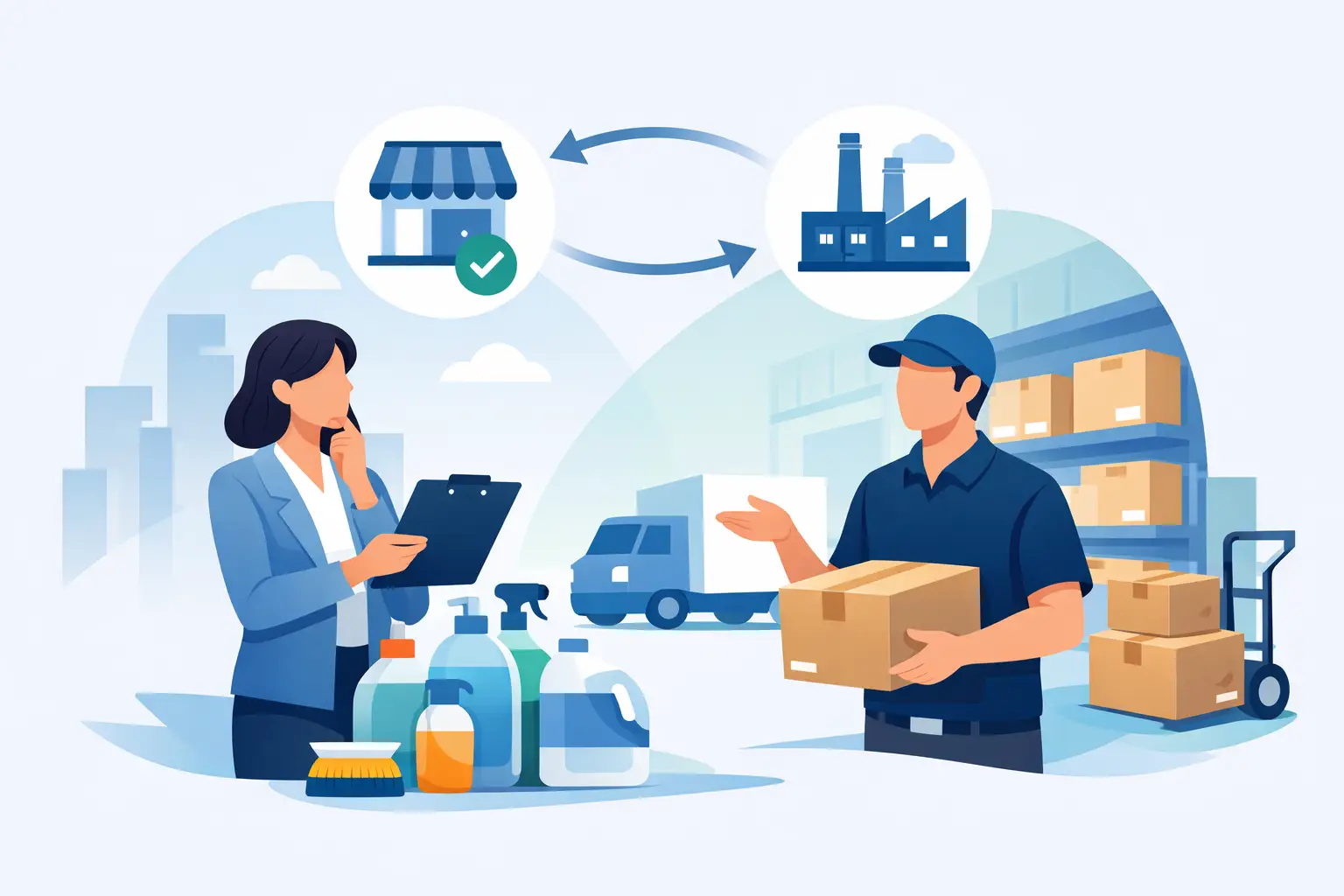

A delayed shipment of detergent, paper goods, or surface cleaners does more than create a stock gap. It disrupts shelf plans, strains customer relationships, and puts pressure on margins that are already tight. That is why choosing the right cleaning products wholesale supplier is not a routine purchasing task. It is a commercial decision that affects continuity, pricing discipline, and your ability to grow with confidence.
For wholesalers, retailers, distributors, and importers, the best supplier is rarely the one offering the lowest unit cost on a single order. In practice, long-term value comes from dependable stock availability, consistent product quality, broad assortment, and a supply structure that can support repeat volume. In the cleaning category especially, reliability matters because demand is steady, replenishment cycles are frequent, and buyers expect practical performance at the right price point.
What a cleaning products wholesale supplier should deliver
A capable cleaning products wholesale supplier should help simplify procurement, not add another layer of uncertainty. Buyers in this category often need more than one or two SKUs. They may require dishwashing liquids, laundry products, floor cleaners, disinfectants, wipes, sponges, brushes, trash bags, air care products, and related household essentials in the same purchasing cycle. When these items must be sourced from multiple vendors, administration expands, lead times become harder to manage, and inconsistencies start affecting fulfillment.
A stronger wholesale partner provides category depth and practical range. That means serving different price points, pack sizes, and product formats so buyers can match inventory to the needs of supermarkets, neighborhood stores, discount retail, institutional channels, and export markets. A narrow catalog can work for a specialist buyer. For most volume traders, however, assortment matters because it creates efficiency.
Consistency is just as important as range. If a product performs well on first order but changes in packaging, quality, or availability by the third shipment, your business carries the cost. Stable specifications, repeatable quality, and clear communication on stock status are what separate a dependable supplier from a transactional one.
Why supplier scale matters in cleaning wholesale
Scale is not only about warehouse size or catalog count. In wholesale cleaning supply, scale affects purchasing power, continuity, and service resilience. Larger, established trading businesses are often better positioned to maintain broad inventory, negotiate stronger manufacturing terms, and support recurring orders without the same level of supply volatility smaller operators may face.
This matters when markets tighten, freight costs shift, or demand spikes unexpectedly. A supplier with wider sourcing capabilities and established distribution infrastructure is generally better equipped to protect stock flow. That does not mean the largest supplier is always the right one. It does mean buyers should look closely at whether a prospective partner has the operational depth to support growth, not just the ability to fulfill one initial order.
There is also a practical financial advantage. A supplier with scale can often offer more competitive pricing across multiple categories, which helps buyers improve basket economics instead of chasing isolated deals. In many cases, that broader commercial efficiency creates more value than negotiating aggressively on a single product line.
How to evaluate a cleaning products wholesale supplier
The first question is not price. It is whether the supplier can support your business model. A distributor serving modern trade may need standardized packaging, reliable repeat availability, and strong delivery discipline. An exporter may care more about documentation, mixed-container capability, and market-appropriate assortment. A discount retailer may prioritize opening price points and fast-moving essentials. The right supplier should understand these differences and respond accordingly.
Product breadth should be assessed with care. A broad catalog is useful only if it includes commercially relevant items with dependable turnover potential. Ask whether the supplier can support both branded and private-label needs, whether pack sizes match your sales channels, and whether the cleaning range connects logically to adjacent household categories. Cross-category buying can reduce complexity and improve purchasing efficiency when managed through one experienced trading partner.
Stock reliability is another key measure. Buyers should understand how inventory is managed, which items are held consistently, and how substitutions or replenishment delays are communicated. Frequent gaps create downstream costs that are rarely visible in the first quotation.
It is also worth examining how the supplier handles volume changes. Some partners are efficient at standard wholesale orders but struggle when demand increases or when buyers begin consolidating more categories with them. A dependable wholesale source should be able to support scaling requirements without a drop in service quality.
Pricing is important, but so is pricing structure
Every buyer wants competitive pricing, and rightly so. But headline pricing alone can be misleading. A low initial quote may be offset by inconsistent stock, variable lead times, limited assortment, or the need to buy from additional vendors to complete an order.
A better approach is to assess the full pricing structure. Look at pricing consistency across repeat orders, the ability to support mixed-category purchasing, and the commercial terms available at higher volumes. It is often more efficient to work with a supplier that offers strong value across a broad range than to split orders among several sources chasing marginal unit savings.
This is especially relevant for businesses managing resale margins across different customer segments. Stable pricing supports better forecasting and more confident promotions. Unpredictable pricing, by contrast, creates pressure throughout the chain, from procurement to retail execution.
The value of export capability and regional trade experience
For many volume buyers, the supplier relationship extends beyond domestic wholesale. Export handling, documentation accuracy, and regional market familiarity can be just as important as product availability. Cleaning products move across diverse markets, and requirements can vary depending on destination, packaging expectations, and buyer preferences.
An experienced supplier with established international trade capabilities can reduce friction considerably. This includes managing large orders, coordinating documentation, understanding shipment schedules, and supporting buyers across the UAE, Africa, Asia, Europe, and the Middle East. For importers and regional traders, that infrastructure is not a secondary benefit. It is part of the core value.
This is where legacy and relationships matter. A long-established trading house typically has stronger manufacturer ties, more stable procurement channels, and practical knowledge of what different markets require. Those advantages are difficult to replace with short-term price shopping.
Why long-term relationships outperform one-off buying
In wholesale cleaning supply, repeat business tends to outperform transactional purchasing. The reason is simple. The more your supplier understands your turnover patterns, preferred categories, target price bands, and seasonal shifts, the easier it becomes to plan effectively.
A relationship-centered supplier is more likely to help you manage continuity, recommend relevant additions, and support category expansion when demand changes. That kind of cooperation has direct commercial value. It can improve fill rates, reduce procurement time, and support better inventory planning.
For this reason, procurement teams should look beyond the first deal. Consider responsiveness, communication clarity, and willingness to support long-term business development. A supplier that treats your account as an ongoing commercial partnership will usually create more value over time than one focused only on immediate transactions.
One-stop sourcing can reduce complexity
Many buyers now prefer to consolidate purchasing where it makes operational sense. If your cleaning assortment can be sourced alongside household goods, kitchen items, personal care products, and other fast-moving categories, your procurement process becomes more efficient. It reduces supplier management overhead and can strengthen overall buying power.
This approach is particularly useful for traders, resellers, and distributors serving broad retail networks. Instead of coordinating multiple small relationships, they can work through one established source with the assortment, pricing discipline, and fulfillment capacity to support regular wholesale demand. That is one reason companies such as Fakhruddin General Trading continue to be valued by regional buyers seeking scale, range, and dependable supply from Dubai.
Still, consolidation is not always the right answer. Some businesses benefit from specialist suppliers in highly technical categories or local niche products. The practical decision depends on your volume profile, product mix, and market strategy. The key is to choose a partner whose structure fits your business, not just your next order.
A better standard for supplier selection
A cleaning products wholesale supplier should bring more to the table than inventory. The right partner supports business continuity, protects margin through competitive and stable pricing, offers meaningful assortment, and understands the demands of regional and export trade. For serious buyers, these are not extras. They are the foundation of dependable wholesale growth.
When supply chains are under pressure and customer expectations remain high, the strongest position is built on consistency. Choose a supplier that can keep pace with your business now and still be the right partner when your order volumes, markets, and category needs expand.